
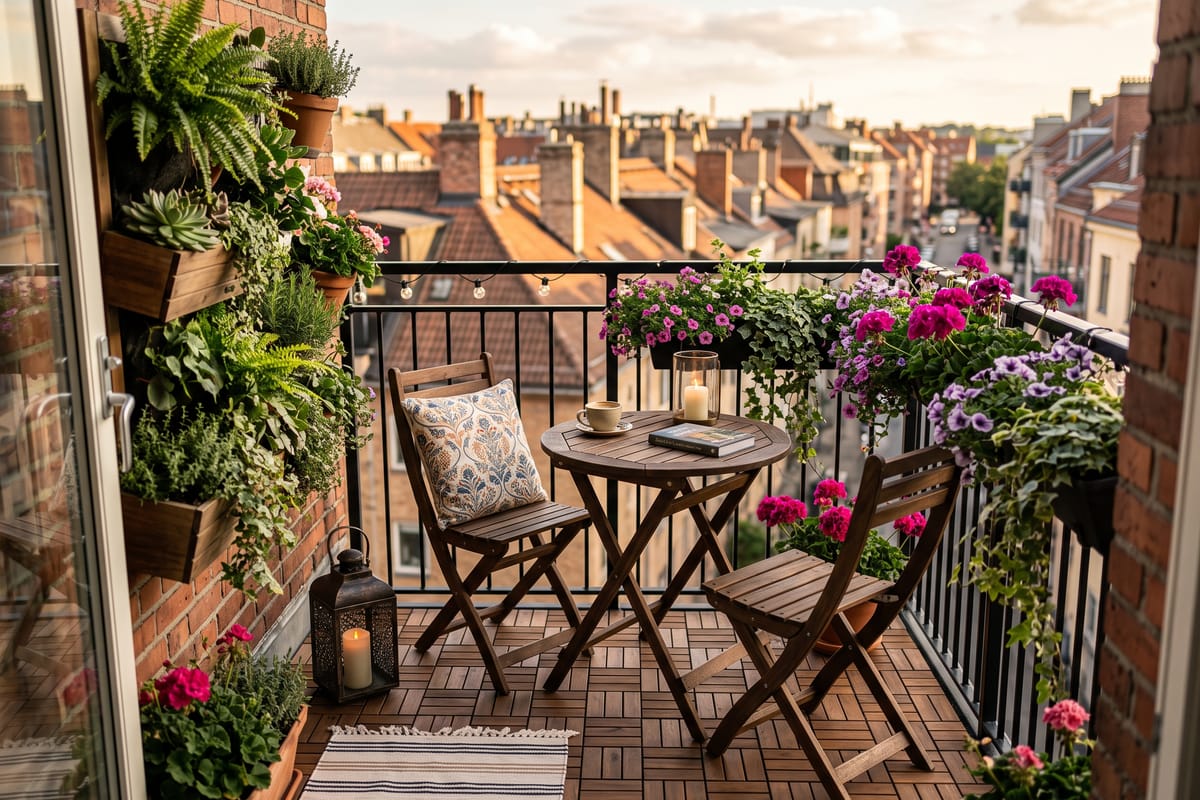
Most balconies run on defaults: a drying rack, a dead plant, one sad folding chair facing the wrong way. Which is a waste, because the balcony is the cheapest extra room you own — it needs no build, no permit and no landlord conversation to become somewhere you actually sit.
Pick one job
Five square meters does one thing well: coffee for two, a solo lounge corner with a real chair, or a green room where the plants are the point. The balconies that stay unused are the ones asked to do all three — half a bistro set, half a storage unit, and no room left to turn around in.
Small-space rules that earn their keep
- Foldable or stackable everything — the balcony has seasons and needs to clear for them.
- Go vertical: rail planters, a trellis, wall pots. The floor is scarce; the walls aren't.
- An outdoor rug turns concrete into floor. Nothing else does as much for as little.
- Battery or solar lights — few balconies have a socket, and evening is the balcony's best hour.
- One tall plant beats ten small pots for making the space read as a garden.
Buy for the wind and the winter
Wind is the tax on balcony furnishing: lightweight pieces migrate and cushions fly. Mind the railing weight limit with planters, choose materials that live outside — powder-coated steel, teak, polyrattan — and know where the cushions spend the winter before buying them.
Render it before the flat-pack
The balcony tool takes a photo of yours — rail, neighboring wall, awkward depth and all — and renders it as each of the three jobs. Pick the one you'd actually use, and the shopping list prices it from real stores while the enthusiasm is still warm.