
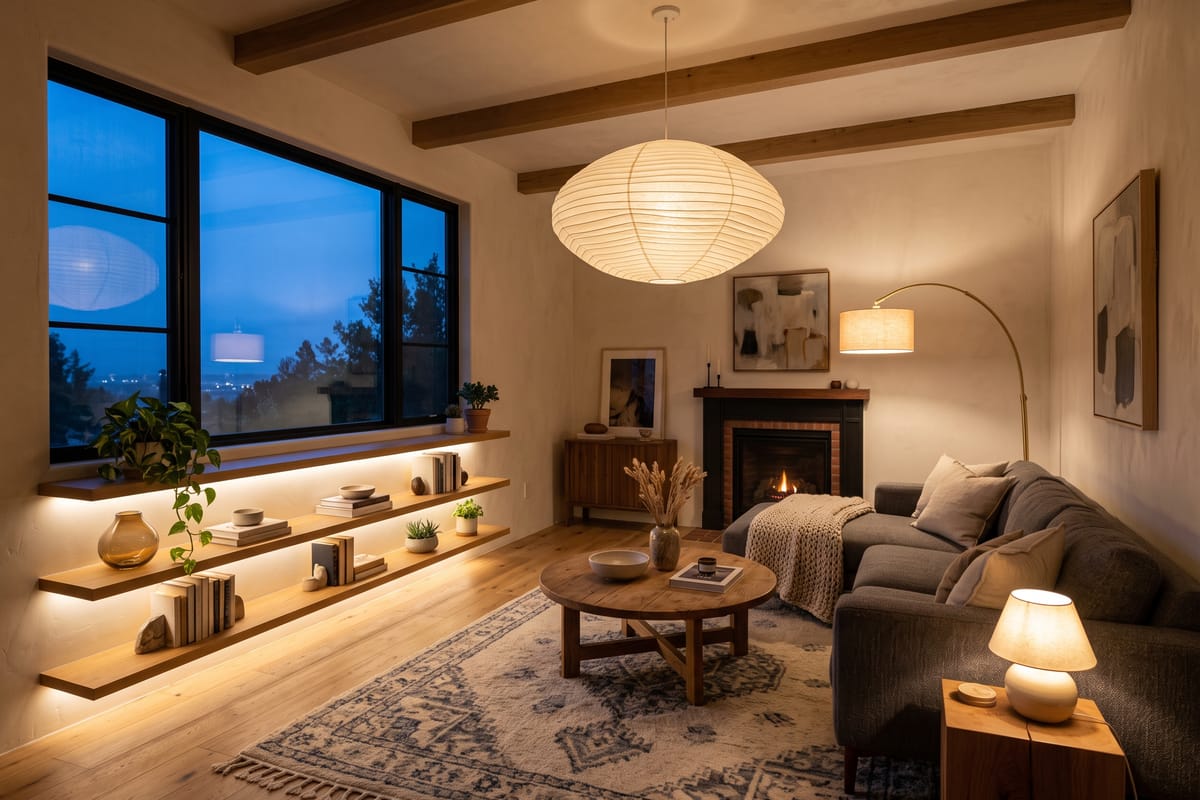
Most rooms have a furniture plan and no light plan — one ceiling fixture doing everything, which is why the room looks fine at noon and like an interrogation at night. Light is the last line in most decorating budgets and the first thing your eye actually reads.
Three layers, every room
Ambient is the general fill — the ceiling fixture, or better, several sources adding up. Task is light to do something by: the reading lamp, the desk lamp, the counter strip. Accent is light aimed at things — art, a plant, a curtain wall — that gives a room depth after dark. A room lit by all three at low levels beats one lit by a single bright source every time.
The $20 fixes come first
- Match every bulb in the room at warm white (2700 K) — the single most common fix.
- Plug-in dimmers on the lamps you already own.
- Move one lamp into the corner that goes dark; a lit corner visually enlarges the room.
- Aim something at a wall or curtain — washed vertical surfaces read as space.
Then plan fixtures like furniture
Past the bulb stage, fixtures are design objects with placement questions — where a pendant hangs, whether sconces flank the mirror, what a floor lamp does to the reading corner. The lighting tool renders those schemes on your own room, statement pendant included, and the fixtures land in the shopping list with live prices like any other piece.
One rule: no mixed whites
A 4000 K bulb in one lamp and 2700 K in the rest is the 'something feels off' that visitors can't name. Pick warm, buy a multipack, and retire the odd bulbs to the garage where color temperature is nobody's problem.