
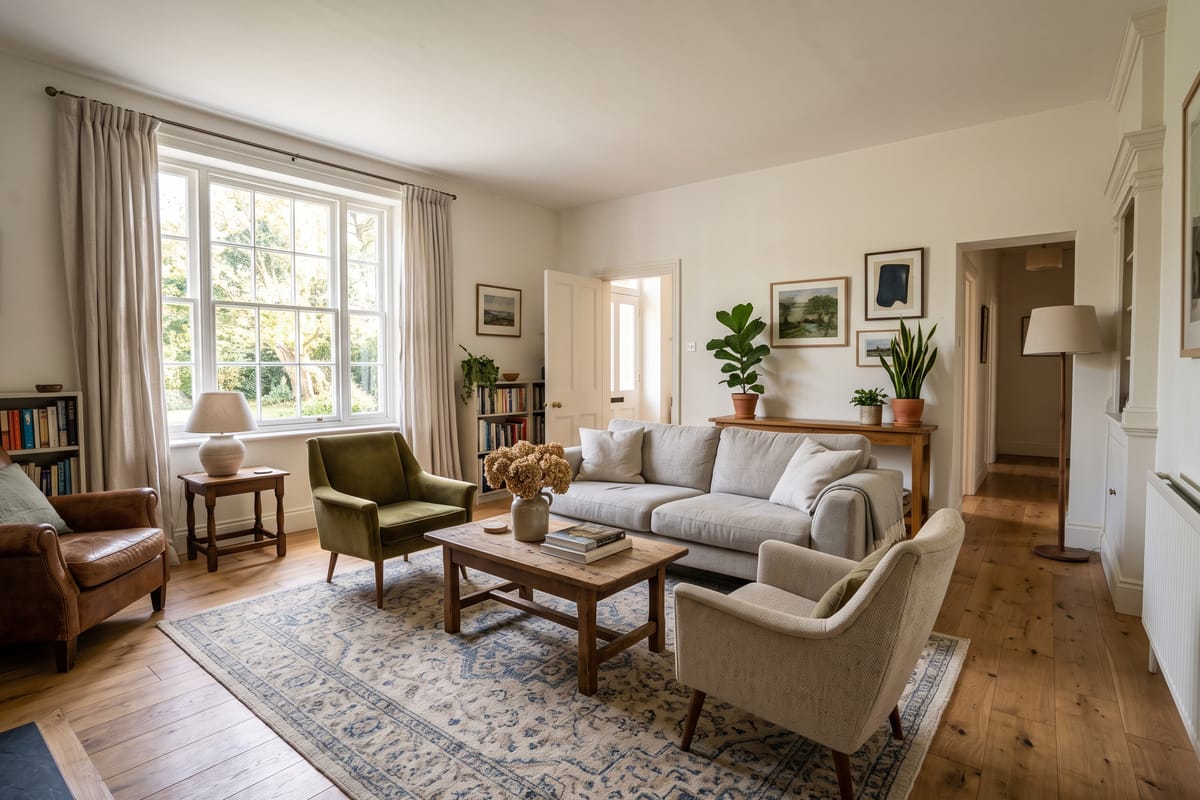
Compare enough before-and-after pairs of small living rooms and the same corrections repeat. The befores are not badly furnished — they are badly arranged, usually by the instinct that says a small room needs everything pushed to the edges. The instinct is wrong, and the fixes mostly cost nothing.
The five repeat offenders
- Everything against the walls: it maximizes empty floor in the middle and makes the room read as a waiting area.
- A rug that floats: if only the coffee table is on it, it shrinks the room. Front legs of every seat should land on the rug.
- The path fights the furniture: the walk from the door to the window shouldn't require a chicane around a chair arm.
- The sofa faces storage: seating aimed at a bookcase or a radiator instead of the window, the TV or the other seat.
- One ceiling light doing everything: flat, shadowless, and the reason the room only gets used in daylight.
Float the sofa, shrink nothing
Pulling the sofa even 20–30 cm off the wall, with a slim console or just air behind it, gives the room depth it visibly didn't have. Depth reads as size. The room loses no usable floor — nobody was standing in that strip anyway.
Rearrange before you buy anything
Layout Boost works with what the photo already contains: it rearranges your own furniture for sight lines and flow, without adding a single new piece. That is the right first render for a small room — it separates 'this room is arranged wrong' from 'this room needs different furniture', and only one of those costs money.
If pieces do get added later, the change filter keeps the shopping list honest: it lists what the AI added, not what you already own.
When the room is honestly too small
Sometimes the render delivers bad news well: the corner sofa never sits right in eleven square meters, in any arrangement. That is worth knowing before the next attempt at pushing it around a wall. A loveseat and an armchair nearly always beat a sectional that fits like luggage in an overhead bin.